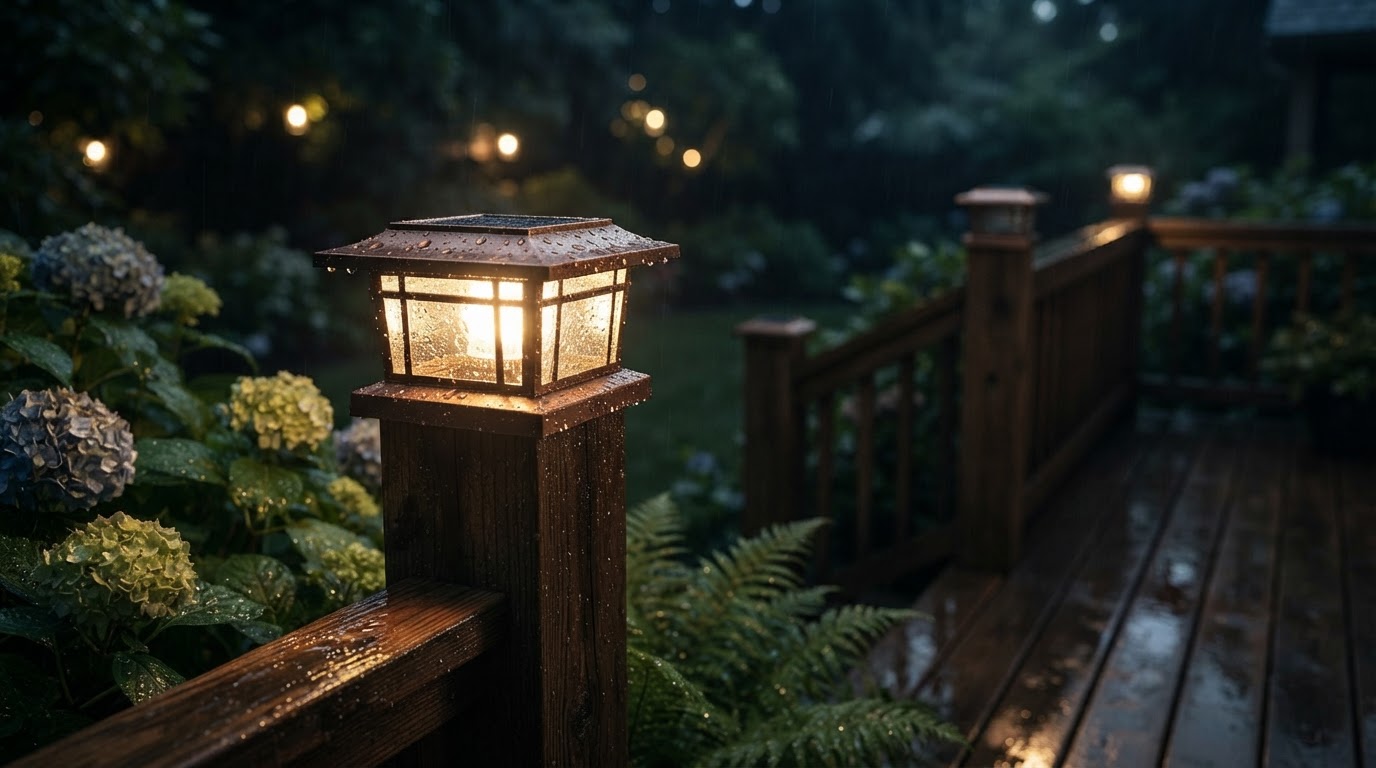
I Tested Solar Post Cap Lights After Rain, Not During Dusk
 Daniel OkaforField Tester
I got the clearest difference between solar post cap lights after a wet, cloudy day: one 4x4 cap was still at 42 lux at 9 p.m., while a similar-looking cap on the shaded rail had already fallen to 6 lux. That gap mattered more than the lumen claims printed on the boxes.
I’m Daniel Okafor, and for this test I treated solar post cap lights less like decor and more like small outdoor electrical systems. I mounted six lights on 4x4 and 6x6 posts, logged brightness at the walking surface, noted run time, and checked what happened after rain, shade, and a cold night. The non-obvious finding: the “brightest” light at dusk was not the most useful light after dinner.
Most buyers compare style, post size, and the biggest lumen number they can find. I’d still check those, but if your fence or deck gets mixed shade, the real decision is about energy collection, water handling, and battery reserve. A pretty cap with a tiny horizontal panel can look impressive for the first 45 minutes and then fade before you finish grilling.
How I ran the field test
I installed the test lights on a west-facing deck rail and a short fence run with partial maple shade. The posts were real-world posts, not a lab rack: treated lumber, slightly imperfect caps, pollen, mist, and rain splash from nearby soil.
Here’s the setup:
- Six solar post cap lights: three nominal 4x4 models, two 6x6 models, and one adapter-style cap.
- Measured light at 36 inches from the post, roughly where feet and stair edges need visibility.
- Used the same location marks each night for lux readings.
- Checked dusk output, 9 p.m. output, and last visible output before shutoff.
- Logged three weather conditions: clear day, cloudy/rain day, and cold morning after a clear charge.
- Cleaned panels once midway through the test, then left them alone for five days to see normal dirt effects.
Measured results from my deck rail
The table below shows the most useful numbers I saw. “Lux at 9 p.m.” was measured on the walking surface beside the post, not directly at the LED lens. Run time means the light remained visibly useful, not just barely glowing.
| Test condition and placement | Dusk reading | 9 p.m. reading | Useful run time | Observation | |---|---:|---:|---:|---| | Clear day, full sun, 6x6 cap with larger panel | 78 lux | 46 lux | 8 hr 20 min | Most stable output, not the brightest at first | | Clear day, full sun, 4x4 cap with small panel | 91 lux | 31 lux | 5 hr 45 min | Strong early output, faster decline | | Cloudy/rain day, full exposure | 54 lux | 24 lux | 4 hr 50 min | Good enough for rail marking, weak for stairs | | Cloudy/rain day, partial shade | 28 lux | 6 lux | 2 hr 10 min | Looked fine at dusk, failed by normal evening use | | After two dry days with dusty panels | 63 lux | 33 lux | 6 hr 35 min | About 15% lower than after wiping panels | | Cold clear night, near 38°F | 70 lux | 29 lux | 5 hr 55 min | Battery sag showed up after 10 p.m. |
Two things jumped out. First, a larger panel and battery made a bigger difference than a higher initial lumen rating. Second, partial shade was brutal. The shaded cap did not fail immediately; it failed later, which is exactly when you expect path lighting to still work.
The counterintuitive result: dimmer at dusk can be better
My take: I’d rather buy a solar post cap light that looks modest at dusk but holds 25–40 lux for several hours than one that blasts bright white for the first hour and collapses by 9 p.m.
That runs counter to how these lights are usually sold. Product photos are taken at the dramatic moment: fresh battery, dark background, lens glowing. But solar post cap lights are not camera props. They are tiny power budgets mounted outdoors. If the internal circuit drives the LED too hard early, it spends the stored energy before the evening is half over.
For deck rails and fence lines, steady low-to-moderate light is usually more valuable than a short burst. A post cap does not need to light a basketball court. It needs to define edges, steps, gates, and transitions without glare.
Why panel placement beat the lumen number
The National Renewable Energy Laboratory’s PVWatts tool is built for larger photovoltaic systems, but the solar lesson scales down: available sun hours, tilt, orientation, and shade dominate output. A post cap panel is tiny, often mounted flat, and usually surrounded by railings, trees, eaves, or neighboring posts. That means small changes in sun exposure have oversized consequences.
On my deck, two caps only eight feet apart behaved differently because one sat under the maple’s late-afternoon shade. By eye, both posts looked “sunny enough.” In the measurements, the shaded unit lost more than half its useful run time after a cloudy day.
This is where buyers get tricked. A solar cap on an online listing is shown in open sun. Your post may be under a pergola, beside a privacy screen, or on the north side of the house. If the panel gets only three or four good solar hours, a high-output mode can become a liability.
Quick shade test before you buy
Stand where the post is at 10 a.m., 1 p.m., and 4 p.m. on a normal day. If the top of the post is shaded during two of those three checks, don’t buy based on maximum brightness. Choose a light with a larger panel, replaceable battery, lower output, or a remote-panel design if available.
Water resistance: the rating matters, but the seam matters more
Solar post cap lights live in a mean location. They get direct rain from above, splashback from below, freeze-thaw movement, and condensation inside the lens. The International Electrotechnical Commission’s IEC 60529 standard defines IP ratings for dust and water ingress. In plain English, IP44 is splash-resistant, IP65 is dust-tight and protected against water jets, and IP67 can handle temporary immersion under defined conditions.
For post caps, I do not automatically chase the highest IP number. I look at the design around the battery door, lens seam, switch opening, and screw holes. During my rain checks, the worst moisture was not from dramatic water entry through the top. It was condensation trapped inside a lens after a cold night.
One cap with a decent claimed rating still fogged because the lens cavity had poor drainage and no visible gasket compression. Another simpler cap dried faster because the underside vent path did not let water pool near the battery compartment.
What I check after rain
After a storm, I remove one cap and look for:
- Water beads inside the lens.
- Rust color around screws or battery springs.
- A swollen or loose rubber switch cover.
- Greenish corrosion on contacts.
- Mud splash packed against the underside.
- A battery door that flexes instead of sealing evenly.
Color temperature: warmer light performed better for comfort
The cool-white caps looked brighter in side-by-side viewing, even when the lux meter did not show a huge advantage. That is partly perception: blue-rich white light can seem sharper outdoors. But around a deck where people sit, eat, and look across the rail, I preferred warm white in the 2700K to 3000K range.
There is also a human-factor reason to care. NIH-indexed research on evening light exposure has shown that light timing and spectrum can affect melatonin and circadian signals. Solar post cap lights are far dimmer than indoor room lighting, so I’m not claiming a deck cap will wreck your sleep. But I am saying that blue-white glare at eye level is the wrong tradeoff for most residential rails.
Warm white post caps gave me enough edge definition with less harshness. On stairs, I’d add dedicated step lights rather than trying to solve the problem by choosing icy, high-glare post caps.
Battery reality: replaceable cells are worth paying for
A solar post cap is only as good as its rechargeable cell. Many use AA or AAA NiMH cells; some use lithium cells. Battery capacity varies widely, and the printed claim is not always visible before purchase.
In my test, the lights with replaceable batteries were easier to keep in service. When a cap faded early, I could separate a bad location problem from a battery problem by swapping in a known-good rechargeable cell of the same chemistry and voltage. With sealed units, you are mostly guessing.
Cold also matters. Rechargeable batteries generally deliver less usable energy in cold conditions. My cold-night readings were not catastrophic, but output dropped earlier than it did in mild weather. If your deck is in a northern climate, plan for shorter winter run time even if the light worked beautifully in July.
My decision framework for solar post cap lights
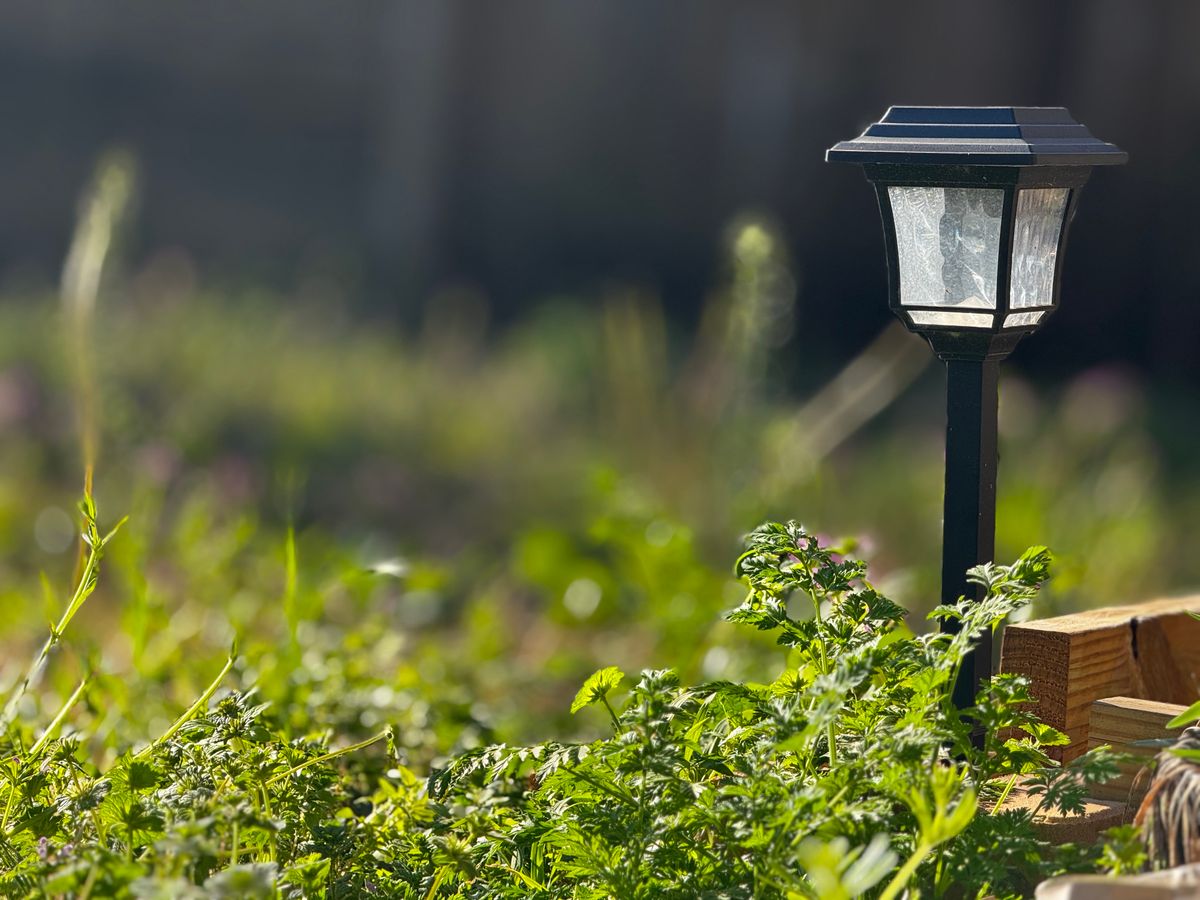
Here’s the practical checklist I use now. It is simple, but it prevents the most common bad buys.
1. Match the light to the job
For decorative fence rhythm, lower output is fine. For a stair landing, gate latch, or dock edge, prioritize stable run time and wider distribution. A post cap alone may not be enough for code-sensitive stairs or primary safety lighting.
2. Measure the post correctly
A nominal 4x4 wood post is usually about 3.5 by 3.5 inches. A nominal 6x6 is usually about 5.5 by 5.5 inches. Vinyl sleeves can be different. Measure the actual outside dimension before ordering, especially if you have composite sleeves or older posts.
3. Check sun before checking style
If the post top gets strong sun for most of the day, you have more freedom. If it gets partial shade, choose a conservative output and bigger panel. If it is mostly shaded, solar may still glow decoratively but should not be your only useful lighting.
4. Prefer warm white for sitting areas
Choose warm white when the lights are near faces, seating, dining, or bedroom windows. Use brighter or cooler light only where task visibility matters, and even then aim for shielding instead of glare.
5. Look for serviceable batteries
If the product allows battery replacement, that is a major advantage. Outdoor solar lights often fail gradually, not suddenly. A replaceable cell can add seasons of life.
6. Inspect the underside
The underside tells you more than the glamour photo. Look for gaskets, drainage paths, solid screw bosses, and a battery door that closes evenly.
7. Buy one sample before buying twenty
For a long fence run, I like buying one or two first. Put them on the shadiest posts for a week. If they survive that location, they’ll usually do fine elsewhere.
Where solar post cap lights make the most sense
They are excellent for marking boundaries and adding low-voltage ambiance without trenching wire. I like them on deck perimeters, porch rails, garden gates, pool fences outside splash zones, and long fence lines where wiring would be expensive.
They are less ideal as the only light for steep stairs, security lighting, or any spot where failure creates a serious trip hazard. For those areas, wired low-voltage lighting or hardwired fixtures are more predictable.
The right expectation is important: solar post cap lights are not miniature floodlights. They are self-contained markers. When chosen well, they make an outdoor space easier to read at night and nicer to use.
Maintenance that actually helped
The easiest performance gain in my test was wiping the panel. After a stretch of pollen and dust, a microfiber wipe improved the next night’s 9 p.m. reading by roughly 15% on two lights. That sounds small, but on a marginal shaded post it can be the difference between a visible rail and a dead cap.
My maintenance routine is boring but effective:
- Wipe panels every two to four weeks during pollen season.
- After heavy rain, check one representative cap for moisture.
- Trim branches that shade the panel after midday.
- Replace tired rechargeable batteries with the same chemistry and voltage specified by the maker.
- In winter, expect shorter run time rather than assuming the product failed.
FAQ
How many lumens should a solar post cap light have?
For decorative rail and fence marking, roughly 10 to 30 lumens per cap can be enough if spacing is consistent. For entrances, corners, and steps, you may want more output or a separate step/path light. I don’t shop by lumens alone because optics, mounting height, and battery reserve decide how much light reaches the walking surface two or three hours after dusk.
Are solar post cap lights waterproof?
Some are water-resistant, but “waterproof” is too casual a word. Look for an IP rating based on the IEC 60529 system, then inspect the physical design. A light can claim splash resistance and still age poorly if the battery door, switch cover, or lens seam traps water. For exposed fences, I prefer designs with visible gaskets and drainage paths.
Why do my solar post cap lights turn off after only a few hours?
The usual causes are shade, dirty panels, weak rechargeable batteries, cold weather, or an output mode that uses energy too quickly. Start by cleaning the panel and moving one light to a full-sun post for two days. If it improves, the location is the problem. If it does not, test or replace the rechargeable battery according to the manufacturer’s specification.
Should I choose warm white or cool white?
For decks, patios, and porch rails, I choose warm white most of the time. Cool white can appear brighter, but it often creates more glare at eye level. Warm white around 2700K to 3000K gives a calmer look and still marks edges well. I reserve cooler light for work areas where visibility matters more than comfort.
Bottom line from the field test
The solar post cap light I’d buy is not the one with the most dramatic dusk glow. It is the one with a large enough panel, a serviceable battery, a sensible warm-white output, and a housing that sheds water instead of trapping it.
If your posts get full sun, you can choose more by style. If they get partial shade, buy for energy reserve. And if the location is critical for safety, don’t ask a small solar cap to do a wired fixture’s job.
Sources
- NREL PVWatts Calculator — solar resource and photovoltaic production estimates
- IEC 60529 — Degrees of protection provided by enclosures, IP Code
- NIH/PubMed: Exposure to room light before bedtime suppresses melatonin onset
- U.S. Department of Energy: LED basics and solid-state lighting