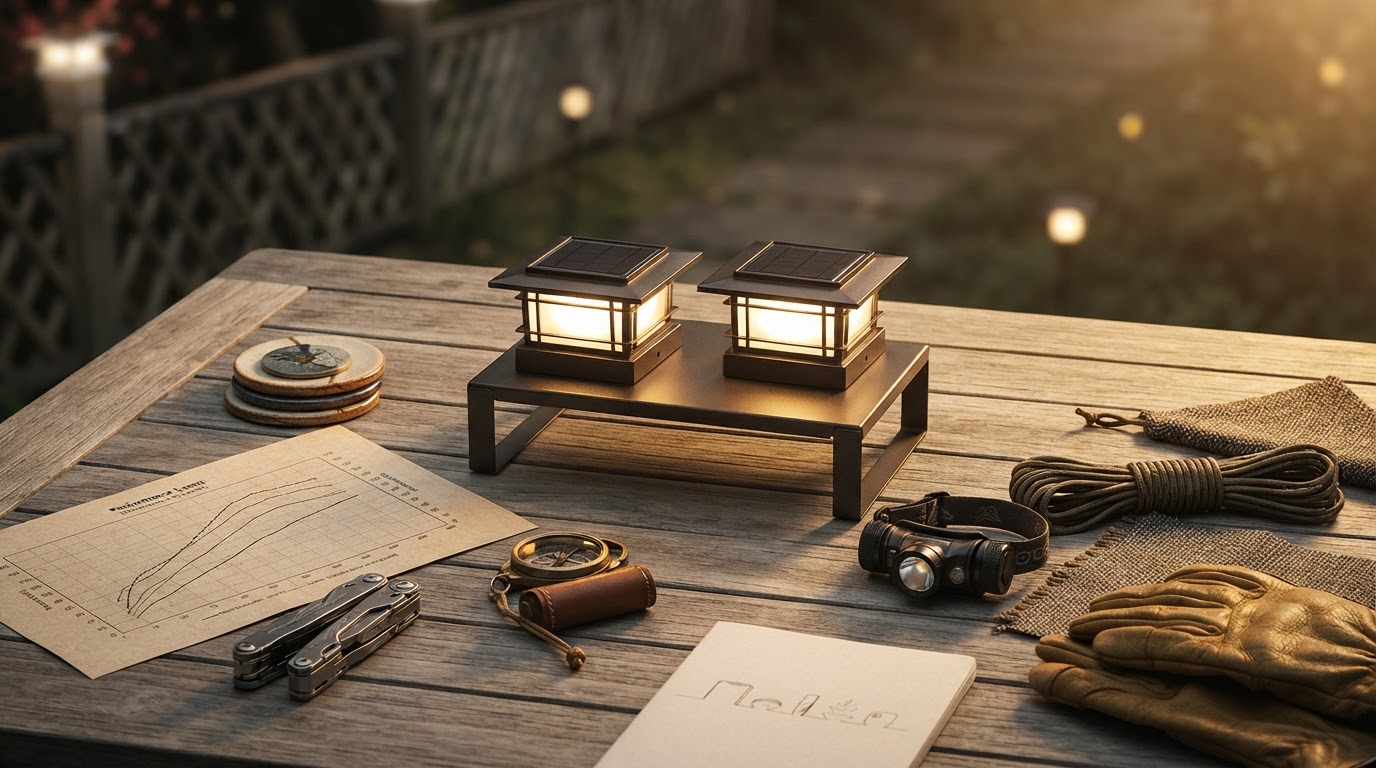
Solar Post Cap Lights for Maximizing Lumens
 Maya ChenContributing Editor
October 2, 2026. This analysis evaluates the technical limitations and performance benchmarks for high-output solar lighting fixtures. It is intended for property owners prioritizing visibility and safety over mere decorative ambiance.
The Efficiency Gap in Perimeter Lighting
The conventional wisdom says that solar-powered fixtures are inherently dim, suitable only for marking a path rather than illuminating a space. Most off-the-shelf units struggle to clear the 10-lumen threshold, which serves a decorative purpose but fails to provide functional security. According to Bob Vila, testing reveals a massive variance in performance, where entry-level units produce as little as 10 lumens while high-end models can exceed 200 lumens. The problem lies in the surface area of the photovoltaic cell relative to the draw of the LED. When homeowners install standard 4x4 solar post caps without checking the wattage-to-lumen ratio, they often end up with a "glow" rather than a beam. This is particularly problematic for those seeking brightest solar post cap lights to secure large dark zones. Run the math: a standard Ni-MH battery in a cheap plastic housing rarely has the discharge rate necessary to sustain high-intensity output for more than four hours. The market is flooded with "warm white" options that sacrifice visibility for aesthetics, leaving a gap for those who need actual utility. While many consumers look for motion sensor solar post lights to solve this, the baseline brightness of the "always-on" state remains the primary point of failure for most residential installations.
Technical Benchmarks for Solar Post Cap Lights
High-performance Solar Post Cap Lights address these deficiencies by decoupling from the low-cost manufacturing cycles that dominate big-box retail. To achieve a functional level of brightness, the hardware must utilize monocrystalline solar panels and high-capacity lithium-ion or LiFePO4 batteries. Data from Ultra Bright Tech indicates that professional-grade solar post caps are engineered for dusk-to-dawn illumination, a feat that requires precise energy management. For instance, 6x6 solar post caps have a larger footprint that allows for more expansive solar collectors, directly correlating to higher milliamps stored per daylight hour. Here's the part nobody talks about: the lens material matters as much as the bulb. Cheap polycarbonate yellow-outs within 12 months, effectively cutting lumen output by half. Specialized Solar Post Cap Lights utilize UV-stabilized materials and high-output LED clusters that can shift between multiple brightness settings. This level of customization is a hallmark of commercial grade solar post caps, which are built to withstand the rigors of public docks and high-traffic walkways. When you move into the 4x4 solar post cap lights category, the density of the LED array becomes the deciding factor. If the fixture doesn't specify a lumen count or a specific battery chemistry, it is likely a decorative marker rather than a light source. The shift toward black solar post caps and white solar post caps in modern architectural designs hasn't changed the physics of light—you still need a high-efficiency circuit board to drive those LEDs through the night.
A Framework for High-Output Selection
Selecting a fixture based on a stock photo is a recipe for disappointment. The focus must remain on the hardware specs that facilitate sustained brightness. I’ll change my mind when a 10-lumen plastic cap can reliably illuminate a transition step three feet away, but until then, the data points toward higher-voltage systems. When evaluating your options, prioritize the following technical requirements:
- Panel Type: Insist on monocrystalline panels; they offer the highest conversion efficiency in low-light or cloudy conditions compared to amorphous silicon.
- Lumen Rating: Look for a minimum of 30 lumens for decorative use and 100+ lumens for safety-critical areas like stairs or pool decks.
- Housing Material: Aluminum or high-impact ASA resin is mandatory to prevent the internal electronics from succumbing to moisture ingress.
- Battery Chemistry: Lithium-based batteries are superior to Ni-MH for high-drain applications, offering more charge cycles and better performance in extreme temperatures.
- Fitment Precision: Ensure the internal dimensions match your posts—whether 4x4 or 6x6—as a loose fit leads to vibration damage and water pooling.
Shop Solar Post Cap Lights here
Sources
- The Best Solar Post Cap Lights for Your Deck or Fence - Bob Vila
- Solar Post Cap Lights - Lake Lite - Ultra Bright Tech
- Ultra Bright Technologies - DecksDirect