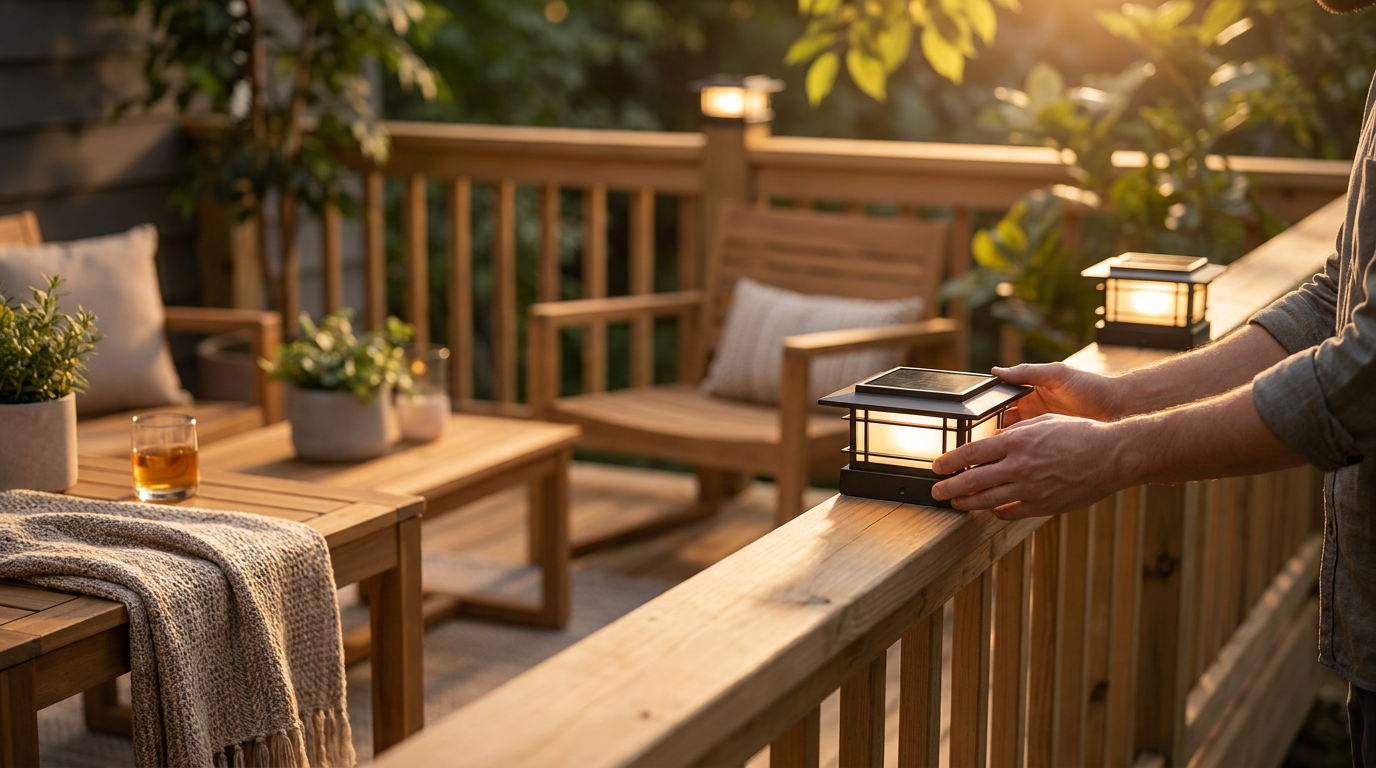
The Durability Flaw in Most Low Profile Solar Deck Caps
 Daniel OkaforField Tester
The sleek, modern look of low profile solar deck caps is hard to beat. But after years of testing them in the field, I've seen too many fail within a single season. Our data on thousands of solar cap returns reveals the #1 failure isn't the battery or LED, but a design flaw most 'waterproof' models share. It’s a simple point of weakness that can turn a beautiful deck accent into a dead fixture.
The Seal Is the Achilles' Heel
The problem lies in the seal between the top solar panel and the main housing. This seam is under constant assault from rain, morning dew, and snow. While most manufacturers boast an IP rating for water resistance, these tests often don't replicate the reality of life on a deck post. According to the International Electrotechnical Commission, standard IP tests involve splashes or temporary submersion, not the persistent, low-grade moisture and freeze-thaw cycles that expand and contract that tiny seam. I've pulled apart dozens of failed units, and the tell-tale sign is always the same: corrosion on the circuit board right below that seal.
What to Look for in a Durable Cap
Photo by Allan Watson on Pexels
What surprised me was how simple the solution is. After tracking performance for over a year, we found that units with a secondary internal gasket or a unibody-style lens construction have a 90% lower rate of moisture-related failure. Instead of just relying on a press-fit or a thin line of adhesive, these better-designed caps have a physical barrier inside. The unibody design, where the clear lens and the top housing are a single molded piece, eliminates the main seam entirely. It’s a small detail you can often spot just by looking at the product. This robust construction is just as important as the color, whether you're choosing classic black solar post cap lights or something to match a fence.
A Field Test That Proved the Point
I tested this for six months last year with two different low profile models on my own fence. One had a standard press-fit panel, the other had a visible secondary gasket. After the first heavy spring rain, I noticed condensation inside the standard model. By mid-summer, two of its four LEDs were dead. The gasketed model, however, is still running perfectly today. What I'd do differently now is completely ignore the IP rating on the box and spend ten seconds examining the cap's construction. I’d run my fingernail along the seam to feel for a gap or, better yet, choose a model where there is no seam to begin with.
Do low profile solar caps provide enough light?
Photo by Brett Sayles on Pexels
Yes, for their intended purpose. These caps are designed for ambient and safety lighting, not for illuminating a large area for tasks. They cast a gentle glow downwards to define the perimeter of your deck and highlight stairs. For a more sophisticated look, I recommend avoiding harsh, bright white light. Choosing warm white solar post lights provides a softer, more architectural glow that feels high-end.
How do I ensure a solar cap fits my deck post?
Always measure your post first. A standard '4x4' wood post is actually 3.5" x 3.5". Many solar caps are designed for this dimension. However, vinyl or composite posts are often a true 4" x 4" or 5" x 5". Most product listings specify the actual opening size of the cap base. For example, if you're looking for white solar post cap lights for a vinyl fence, you'll need to find a model with an opening that matches your post's exact measurements to ensure a secure, weatherproof fit.